

Your prospects are searching for Architects on Google right now. If you don’t appear in the top search results, it doesn’t matter how great your roofing services are—they’ll hire someone else.
Why?
Because they’ll be able to find other roofing companies. But not you. Search engine optimization (SEO) can fix this.
SEO has the power to rank your business on top of the search results. Meaning potential customers will see you first, instead of your competitors.
Take this Washington-based Architect as an example. They saw significant organic (unpaid) traffic gains after implementing an SEO campaign and ranking for important keywords related to their services.

In addition to keyword rankings, the company received more leads and calls from potential clients.

This is just one example of the countless ways that the right SEO strategies have helped businesses grow.
In this guide, you’ll learn how you can use SEO to turn your own prospects into paying customers.
How to Start Doing SEO for Your architecture Business
Follow these steps to start doing SEO for your architecture business and grow your online presence:
Step 1: Optimize for Local Visibility
You want people who are physically near you to discover your services and choose to hire you over the competition.
Local SEO is a branch of SEO that focuses on increasing your business’s local search visibility so you can attract more customers in your area.
One sign that you’re doing great in local SEO is if your business appears in the Google Map Pack (sometimes called the local pack). This contains the top three companies that appear in a location-based search.
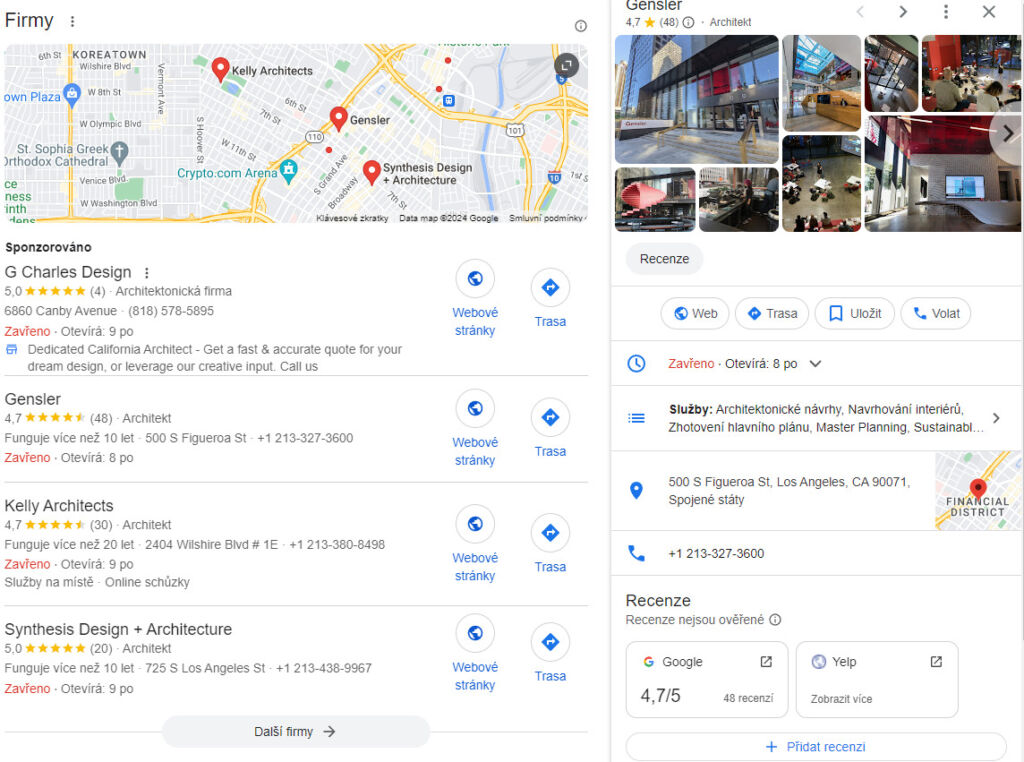
So how does a architecture business show up in the Map Pack?
First, claim and optimize your Google Business Profile (GBP).
You’ll need to enter all your business details, like your business name, address, and phone number (NAP).
Step 2: Create a Strong User Experience (UX) on Your Website
Once clients land on your site, you want them to stay, explore your work, and reach out. Good UX is essential both for conversion and for helping your site rank.
- Communicate your Unique Value Proposition (UVP)
What distinguishes your architecture firm? Is it biophilic design, sustainability, innovative use of materials, heritage renovation, or advanced digital workflows? Make this clear on your homepage and service pages. - Show your portfolio & projects
Use high-quality images, project galleries, case studies, before/after visuals, and design narratives. Let your past work speak. This is especially powerful in architecture, where visuals matter deeply. - Prominently display contact info and calls to action
Ensure your phone number, email, contact form, or consultation request is clearly visible site-wide (header, footer, project pages). Make it as frictionless as possible to reach you. - Mobile responsiveness and speed
Many clients will browse your site on mobile or tablet. It must load quickly, adapt elegantly to different screen sizes, and enable effortless navigation. - Intuitive navigation and information architecture
Organize your site so visitors can find services, portfolios, about page, blog or insight pages within a few clicks. Avoid overcomplicated menus.
Step 3: Do Keyword Research Tailored to Architecture
To attract the right visitors, you need to understand what terms potential clients are searching for in the architecture domain.
- Seed keywords
Start with broader terms like “architect [city]”, “residential architecture”, “sustainable architecture firm”, “commercial architecture office”, etc. - Use tools to expand and filter
Use tools like Semrush, Ahrefs, Moz, etc., to generate related keywords, check volumes, and assess difficulty. - Filter by intent
Classify keywords by intent:- Informational (e.g. “what is passive house design”)
- Commercial/investigative (e.g. “best architecture firms in Prague”)
- Transactional (more rare, but e.g. “hire an architect in Brno”)
- Long-tail and niche keywords
More specific phrases like “minimalist residential architect Ostrava” or “heritage building restoration architect [region]” often have lower competition and higher conversion potential.
Step 4: Apply On-Page SEO Best Practices
Now that you know your keywords, integrate them intelligently on your website pages.
- Title tags & meta descriptions
Craft descriptive, compelling titles and meta descriptions that include your target keywords and invite clicks. - URLs that make sense
Use readable, keyword-rich URLs (e.g.yourdomain.com/services/sustainable-designrather than?page=123). - Image optimization
Since architecture sites are image-rich, pay extra attention:- Use descriptive file names (e.g.
concrete-frame-villa.jpg) - Add alt text describing the image and, where natural, include your keywords.
- Compress images for faster loading.
- Use descriptive file names (e.g.
- Dedicated service pages
If you offer multiple services (residential architecture, interior architecture, restoration, master planning, etc.), give each service its own page. That lets you target specific themes and keywords more effectively. - Internal linking
Connect relevant pages internally (e.g. from a project page to services, or from blog posts back to your portfolio or service pages). This helps search engines crawl your site and helps users discover more. - Structured data/schema markup (if applicable)
Use schema (e.g.,Organization,LocalBusiness,Project) to help search engines understand your content, especially for business details and project portfolios.
Step 5: Publish Valuable, Insightful Content
For architecture firms, content can be a powerful way to build authority, engage clients, and attract organic traffic.
- Blog / Insights / Articles
Write articles about architecture trends, design solutions, material innovations, sustainability practices, case studies, design challenges, or regulatory updates in your area. - Address pain points & client questions
For example:- “How to choose an architect vs. a design-build firm”
- “Steps to get a building permit in [region]”
- “Cost considerations for energy-efficient homes”
- “What happens during the design development phase”
- Project case studies / before–after features
Deep dives into specific projects, challenges you faced, creative solutions, and client feedback. These serve as both marketing and content. - FAQ sections
Collect common client questions (e.g. “How long does an architectural project take?”) and publish them. - Use topic clusters
Create a “pillar” page around a main topic (e.g. “Sustainable architecture”) and link to subtopics (e.g. “passive house design,” “net-zero building details,” etc.). This helps with thematic authority.
Step 6: Acquire High-Quality Backlinks & Mentions
Backlinks (other websites linking to yours) are among the strongest signals for search engines that your site is credible.
- Architecture / design directories & associations
Get listed in professional architecture associations, design forums, sustainability networks, architecture award sites, regional building organizations. - Guest articles / thought leadership
Reach out to architecture magazines, design publications, regional development journals, or real estate & construction industry blogs to write articles or insights, and link back to your site. - Media mentions & PR
Submit press releases for your completed projects, especially unique or noteworthy ones (eco-design, heritage renovations, landmark commissions). Local newspapers, trade publications, and architecture critiques can give mentions and backlinks. - Collaborations & partnerships
Partner with complementary firms (landscape architects, engineers, interior designers) or suppliers (material manufacturers, sustainable tech firms) — sometimes you can get featured or linked in content they publish. - Backlink gap / competitor analysis
Use SEO tools (e.g. Semrush’s Backlink Gap) to see which websites link to competitor architecture firms but not to you. Those are good targets to approach.
Step 7: Track Performance, Adjust, and Measure ROI
SEO is not “set it and forget it.” You need to continuously measure, test, and refine.
- Analytics & tracking
Use Google Analytics (or GA4) to monitor traffic, behavior, and conversions (e.g. contact form submissions). Add goals for lead submissions. - Rank tracking / SEO tool data
Track your keyword rankings, domain authority, organic traffic, and compare against competitors. - Key performance indicators (KPIs)
Some metrics to monitor:- Organic traffic (visitors from search engines)
- Leads (inquiries initiated from organic channels)
- Keyword positions (esp. for high-value commercial/investigative terms)
- Backlink growth
- Engagement metrics (bounce rate, pages per session, session duration)
- Calculate ROI
Compare the revenue or value gained from leads via organic search against the cost of SEO (tool subscriptions, content creation, agency fees, or internal labor). SEO is often medium to long term — results may take 3–6 months or more to accelerate.
Special Tips for Architects
- Visuals matter a lot — invest in high-quality photography, drone shots, renderings, detail images.
- Use project names, locations, and architectural typologies in your content (e.g. “Villa in Moravia,” “Adaptive reuse project Prague”) — these can help with locality and niche SEO.
- Showcase awards, certifications (LEED, Passive House, BREEAM, etc.) — these can be both trust signals and content hooks.
- Use local languages, region-specific building terms, and relevant regulatory keywords (e.g. building codes, heritage regulations) to attract local clientele.
- Use architectural terms (“design development,” “schematic design,” “construction documentation”) in content to align with searchers looking for professional, knowledgeable firms.
5 Benefits of SEO services for architecture companies
From boosting organic rankings to providing long-term cost-effective marketing, SEO will help your architecture business thrive in an increasingly competitive market.
Increased visibility
Quality SEO ensures your architecture business is easily discoverable by potential clients searching for architect services online. The higher your site ranks, the more likely potential customers are to click through to your website.
Cost-effective
While it requires upfront investment, SEO provides long-term benefits by continually driving traffic to your website without ongoing ad spend.
High quality leads
SEO helps you attract visitors are actively searching for the services you offer. This ensures the traffic you receive is higher in volume and more qualified.
Local credibility and trust
When potential clients see strong ratings and read positive feedback, they’re more likely to trust your business and choose your services over competitors.
Improved user experience
SEO isn’t just about pleasing search engines—it’s also about creating a better experience for your website visitors. Optimising your site for speed, mobile-friendliness, and easy navigation ensures potential customers can quickly find the information they need.
FAQs about SEO services for architecture companies?
It’s natural to have questions before outsourcing your company’s SEO. Here are some of the FAQs we’ve been asked.
Why should I outsource my SEO?
SEO requires ongoing effort. With outsourcing, you benefit from the expertise of a professional SEO team that stays updated on the latest industry trends and algorithm changes.
How much does it cost to outsource SEO?
The cost of outsourcing your architecture SEO will vary depending on the scope of services, the size of your business, and the competitiveness of your local market. However, our
Is outsourcing SEO cost-effective?
Our professional SEO agency also delivers measurable results, ensuring your investment leads to sustainable growth. While it may seem like a significant investment, the long-term ROI can far outweigh the initial costs.
How long does it take to see results?
SEO is a long-term strategy, and while outsourcing can accelerate the process, it typically takes 3 to 6 months to start seeing results.
Can outsourcing SEO help with my Google Business Profile?
Yes, we include Google Business Profile (GBP) management as part of our local SEO services.
Benefits of hiring a architecture SEO agency
Hiring a creative SEO marketing agency can be a game changer for companies looking to generate high-quality leads and build a pipeline of new customers.
Here are just some of the benefits of working with us:
- Targeted leads: We ensure that the leads you receive are highly targeted and specifically interested in your services, increasing your chances of conversion.
- No commission: Unlike some lead generation services, we don’t charge commission. Instead, our flat fee allows you to maintain control of your budget.
- Industry experience: We know how to generate results within the home improvement industry and work with a wide range of companies throughout the UK.
- No long-term contracts: You can assess the performance and ROI of our lead gen strategies without the pressure of long-term agreements.
If you’re ready to supercharge your business growth, contact our specialist at digimea@digimea.com today. Book your free strategy session TODAY.